Lou Kasischke
The ClimbLou Kasischke, a fifty-three-year-old attorney from Bloomfield Hills, Michigan, was a client-climber on Rob Hall’s expedition whose defining act on the May 10 summit push was to turn around. At the back of a traffic jam below the South Summit, he faced the choice between continuing toward the top and accepting that the descent might cost his life or his fingers. He chose to go down. The choice was neither easy nor automatic: it took shape over several minutes of listening to competing impulses, and its consequences became stark when he returned to Camp IV ahead of his missing tentmates and rode out the storm alone.
Identity and Background
Kasischke was one of Hall’s clients, sharing a Camp IV tent with guide Andy Harris and fellow clients Beck Weathers and Doug Hansen. Before the climb resumed, the four discussed whether to attempt the summit in the continuing storm. Harris was the only one who favored going; the other three thought waiting would be wiser. The concern was not simply the wind at high camp, but the absence of a full twenty-four hours of good weather and the danger of trying to descend if conditions remained poor.
The conversation gave Kasischke’s later decision a context beyond individual endurance. He had already considered the risk of a summit bid before leaving camp, yet once he was high on the route, the ambition to continue exerted a powerful pull. His account does not present turning back as the effortless application of a rule. It shows a climber having to recover, under strain, the ability to judge what the descent would demand.
The Logjam and the Decision to Turn Back
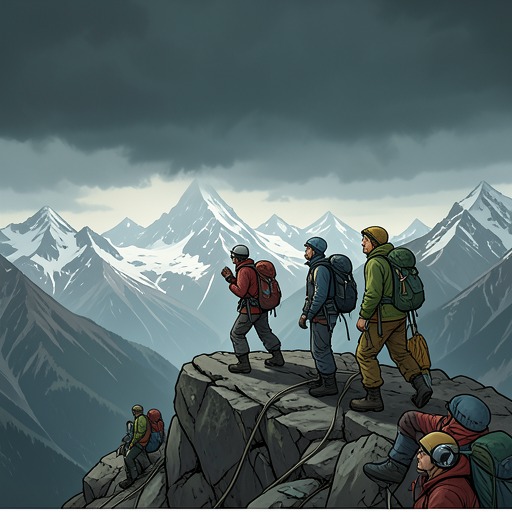
By late morning, climbers were bottlenecked on the ropes below the South Summit. Kasischke was near the back, behind the slow-moving Taiwanese climbers, and the delay made the one o’clock turnaround time increasingly difficult to meet. He passed John Taske and then encountered Stuart Hutchison coming down. Hutchison believed Hall would turn everyone around because the jam left too little time to return by the deadline. Kasischke remembers answering that he was not ready yet and moving on, though he did not get far.
At about 11:30, while waiting below the South Summit, Kasischke clipped into the rope and dropped to his knees to rest. He was severely dehydrated; the water in his pack had frozen solid, so he removed a glove and scooped snow. He already knew his fingers were frostbitten. In the moment, he had been so intent on reaching the summit that this warning had not stopped him. The pause made his condition harder to ignore: he began to assess how fatigued he was and noticed that the clear, spectacular views he had seen from the Balcony had given way to poor visibility as the weather changed.
Kasischke asked Lhakpa, one of the Sherpas, how much farther they had to go. Lhakpa estimated two hours and put their elevation at 8,700 meters. Kasischke later recalled that he could not readily translate the altitude into the feet his mind usually used. The estimate of two hours, however, landed with immediate force. Reaching the summit was still within his capacity, he thought; getting back down alive was the question.
The choice became a struggle between two internal voices. One urged him to continue because another two hours seemed manageable. The other warned that he might die on the descent or lose his fingers even if he survived it. Over four or five minutes, Kasischke concluded that he could not make the round trip safely. He told Lhakpa to go and inform Hall that he had decided to return. Hutchison’s earlier warning may have contributed, but Kasischke was clear that the decision rested on his own assessment of whether he could reach the top and get back in one piece.
Turning Back and Meeting Fischer
At about 11:40, Kasischke started down. Hutchison and Taske also turned around, ending their summit attempts. The episode distinguishes the practical force of the deadline from the personal force of the choice: the logjam and the one o’clock rule framed the danger, but Kasischke’s immediate reasons were his condition and the prospect of an unsafe descent.
Around noon, he met Scott Fischer and told him that returning seemed the smart decision. Fischer looked at him and replied, “Good decision, Lou.” Kasischke remembered the familiar warmth of Fischer’s appearance, with snow in his hair, and their brief exchange: they spent roughly thirty seconds together before heading in different directions. In a day when continuing toward the summit could dominate judgment, Fischer’s approval marked the turn back as a legitimate choice rather than a failure.
Kasischke later set his ambition against the different pressures he believed surrounded some members of the expedition. He wanted to climb Everest, but expected to return to Detroit, where few people would know or care much about the achievement. Media attention, fame, fortune, and records were not, in his view, the stakes he carried. The summit mattered, but it did not crowd out every other consideration. That perspective helps explain how he could acknowledge the strength of the urge to go on while still deciding that the descent mattered more.
Alone at Camp IV
Kasischke reached camp around 4:30 or 5:00 P.M. and collapsed into his sleeping bag, exhausted. His tentmates—Harris, Weathers, and Hansen—had not returned. A short distance away, Anatoli Boukreev was also alone in his tent. Kasischke’s early return therefore brought him to safety from the summit route without bringing him out of danger: the storm at high camp would become a separate ordeal.
The wind woke him by lifting the floor of the tent, raising him in his sleeping bag, and slamming him back down. He could not see and was initially confused about where he was, what time or day it was, and why he was alone. After he recognized that he was at high camp, snowblind and caught in the full storm, he called for help. The roar was so overwhelming that someone only five feet away could not hear him. He eventually understood that leaving the sleeping bag or attempting to go anywhere could mean death, and stayed put through hours of isolation, unable to find out what had happened to the others.
Kasischke’s account closes the gap between a successful turnaround and a safe return. He had judged correctly that continuing up could leave him unable to descend, but turning back did not end his exposure to the mountain’s danger. His story rests on that contrast: a deliberate retreat from the summit followed by a night when survival depended on remaining still in a tent as the storm battered it and his companions remained missing.